



By Anil Anwar | Contributor, Asia
Long before modern borders divided South Asia, the princely state of Bahawalpur stood as one of the most influential and fascinating kingdoms in the region. Rising from the collapse of the mighty Mughal Empire, Bahawalpur became a symbol of royal prestige, political survival, and cultural sophistication in the heart of the subcontinent.
For nearly two centuries, the powerful Abbasid dynasty ruled this desert kingdom with authority and ambition. During much of that time, Bahawalpur existed under British protection, balancing local independence with colonial influence. Yet despite foreign oversight, the state maintained its distinct identity and royal traditions.
A Kingdom Born from Chaos
The mid-eighteenth century was a turbulent period across the Indian subcontinent. As Mughal power weakened, a political vacuum emerged, giving rise to more than 500 semi-autonomous states and regional fiefdoms. Among them, around 70 princely rulers carried the prestigious title of “supreme king.” One of the most remarkable was Bahawalpur.
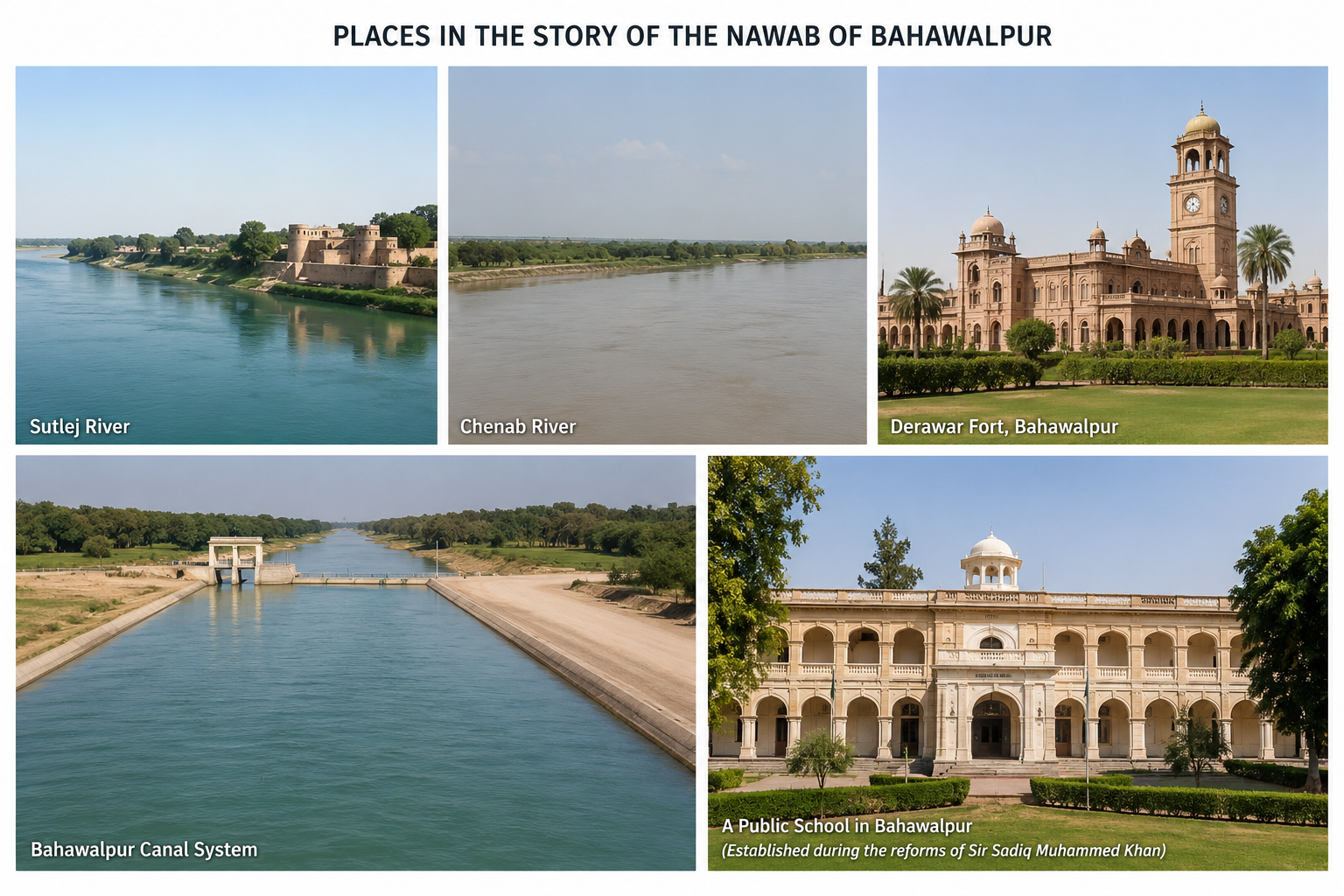
Stretching across nearly 45,911 square kilometers near the confluence of the Sutlej and Chenab Rivers, Bahawalpur occupied a strategic and culturally rich region. The state was governed by descendants of the Daudputra family, whose leadership transformed the kingdom into an important political force in what is now Pakistan.
The Rise of Sir Sadiq Muhammad Khan
Among Bahawalpur’s most notable rulers was Sir Sadiq Muhammad Khan, who succeeded to the throne in 1866. Because he was still a minor at the time, British and Indian administrators initially managed the state’s affairs. But as he matured into leadership, Sir Sadiq Muhammad Khan proved himself to be more than a ceremonial ruler.
In 1880, he was honored with the prestigious title of Knight Commander of the Order of the Star of India, a recognition reserved for influential rulers and statesmen under British India.

Under his administration, Bahawalpur witnessed major reforms that improved the lives of its people. A modern canal system was introduced to expand irrigation and strengthen agriculture across the arid landscape. Education also became a priority, with the establishment of improved public schools that opened new opportunities for future generations.
A Portrait of Royal Elegance
One of the enduring visual records of the Nawab’s legacy is a striking half-length portrait captured by the renowned photography studio Bourne & Shepherd around 1870. The Carte de Visite portrait of Sir Sadiq Muhammad Khan reflects the elegance, dignity, and authority associated with the rulers of Bahawalpur during the colonial era.
The image serves not only as a portrait of a ruler, but also as a window into a forgotten world of princely courts, royal diplomacy, and cultural grandeur.
Advertisement

The Enduring Legacy of Bahawalpur
Today, the story of Bahawalpur remains an important chapter in the history of South Asia. Its rulers navigated political upheaval, colonial pressures, and changing times while preserving their kingdom’s influence and identity.
From ambitious irrigation projects to educational reforms, the Nawabs of Bahawalpur left behind more than palaces and portraits—they shaped a legacy that still echoes through Pakistan’s history and culture.

Nawab-of-Bahawalpur-1870- The Friday Times, Source
This article, previously published on Heartmenders Magazine website, has been updated and republished with an enhanced new title.
Thinking about visiting Asia, Africa, or the United States? Heartmenders Magazine can offer you help. We can provide you with free information if you email your concern to us at heartmendersfoundation@yahoo.com.

Anil Anwar resides in Karachi, Pakistan. He holds a B.Sc. from Shah Abdul Latif University, Khairpur, Pakistan. He was one of the contributors who supported Heartmenders Magazine at its 2014 founding. Contact him at anil.anwar@aol.com. Submit articles to us at editors@heartmendersmagazine.com.