



By Okechukwu Okugo, Founding Editor, USA –
From ancient times, sport has been a part of the culture of people all over the world. Examples include the ancient Greeks’ Olympic observance and the Romans’ massive culture of sports. Thus, the Igbo people of West Africa were not excluded from these kinds of sporting cultural observances.
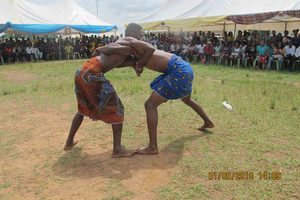
Certain things would culturally bestow honor on both men and women in Igbo societies, and one of such things, which, though in this case, was exclusively reserved for the menfolk, was traditional wrestling. Men of different age groups participate. It can be a leisure activity or a big communal event.
Unlike the Western style of wrestling or other sporting activities, which have involved a lot of blood and gore, with extreme violence that has in many cases led to people losing their lives while participating, Igbo traditional wrestling does not involve any violence. It seeks to determine, between two people, who has more strength, courage, resilience, and physical power, and who will succeed in making his opponent’s back touch the ground.
AD

CLICK ON THE BANNER ABOVE TO GET STARTED TODAY!
Understandably, spectators who would usually gather at the village square to witness the contest cheer the struggles and the grappling for leverage that will enable them to lift their opponent high in the air.
Traditional wrestling is part of the culture of the Igbos and many other African ethnic nationalities. Contests can be organized between two different villages, each presenting its champions to represent the entire community.
Much communal prestige is bestowed on the contestants, so the winner is regarded as having brought honor to the entire village. This is why the champions of various villages were honored and respected among the men and admired among the village maidens. The womenfolk see those champions as men capable of protecting their wives and children.
Most times, in the olden days, families seeking the hand of their daughters in marriage were regarded as privileged; and in most cases, the most beautiful belles were reserved for them.

GMT EMEZUE’S PHOTO OF IGBO TRADITIONAL WRESTLING
One advantage of this tradition was that, in some cases, it protected the entire community. Villages known for many gallant and valiant men who performed well in these traditional wrestling contests were famous, regarded as strong and courageous, and honored among other neighboring Igbo clans. As such, their neighbors would not want to face them in communal skirmishes or warfare. When disputes, such as land disputes, arose between two different Igbo villages, they sought to resolve them through dialogue and a wrestling contest rather than tribal wars. In this way, the sport helped resolve disputes within neighboring communities while also providing social, cultural, and physical benefits.
Note: This post was updated, and its title was changed from its original publication a few years ago.